#Overview
WP Fusion lets you control the visibility of Divi modules, rows and sections based on a logged-in user’s CRM tags.
Requires Divi 5 and a version of WP Fusion newer than 3.48.0. If your site still uses Divi 4, see the Divi 4 section below.
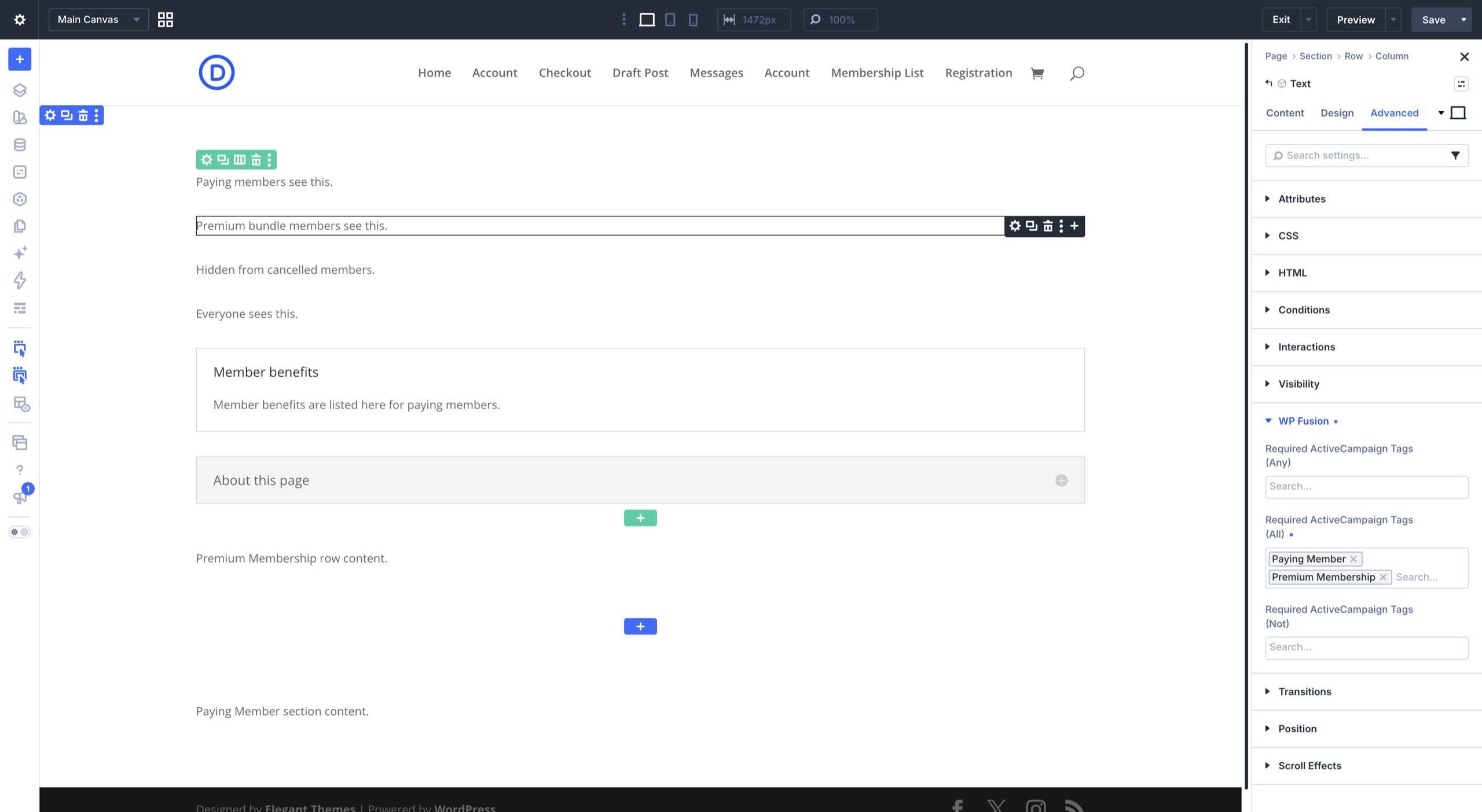
In the Visual Builder, every module except child modules (such as accordion items) has a WP Fusion group under Advanced » WP Fusion.
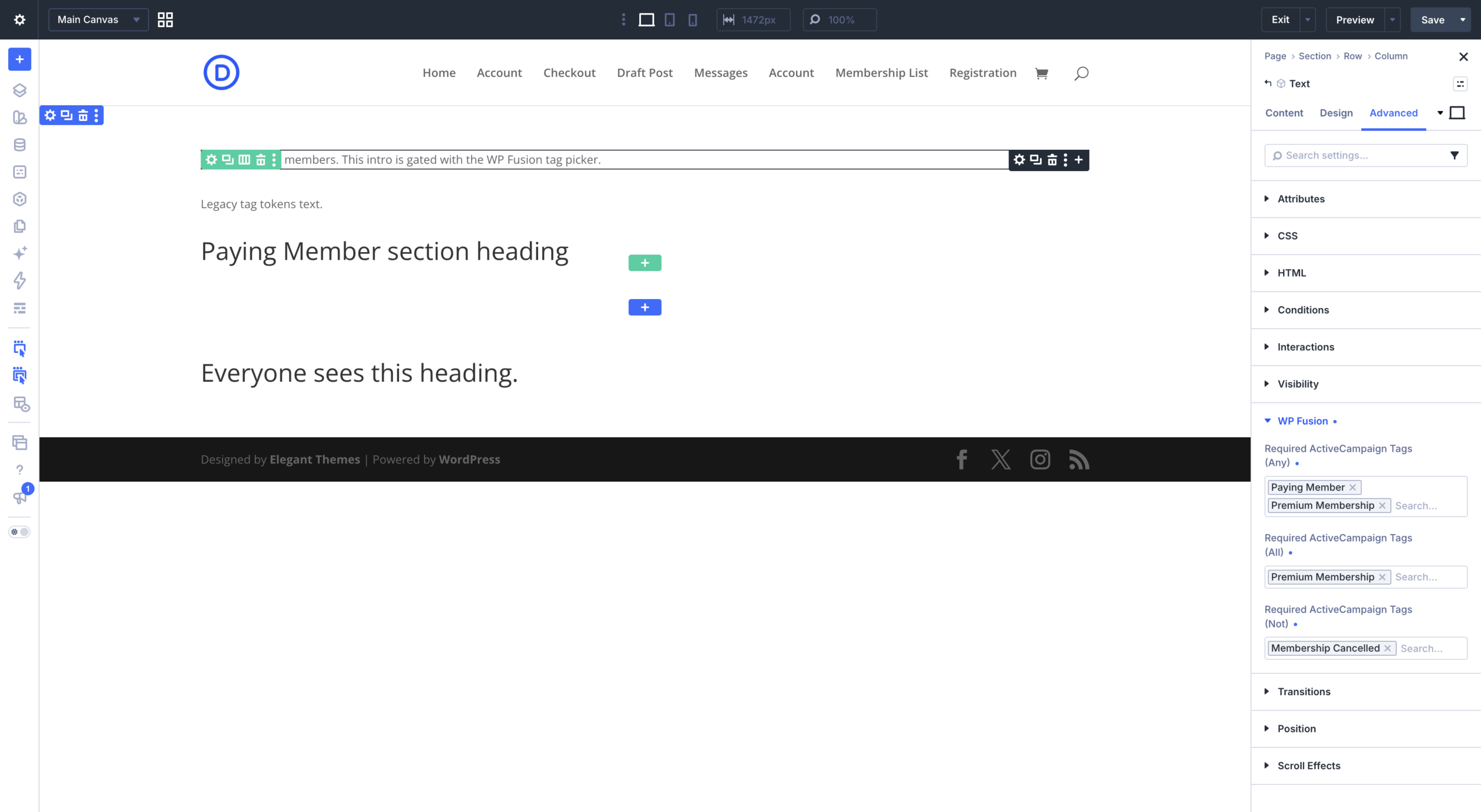
There are three tag pickers, labeled with the name of your CRM (for example Required ActiveCampaign Tags (Any)):
- Required {CRM} tags (any): The user must have at least one of the selected tags to see the module.
- Required {CRM} tags (all): The user must have all of the selected tags to see the module.
- Required {CRM} tags (not): If the user has any of the selected tags, the module will be hidden.
Each picker lists the tags from your CRM and has a search box. Selected tags appear as chips that you can remove with the × on each chip.
#Sections and rows
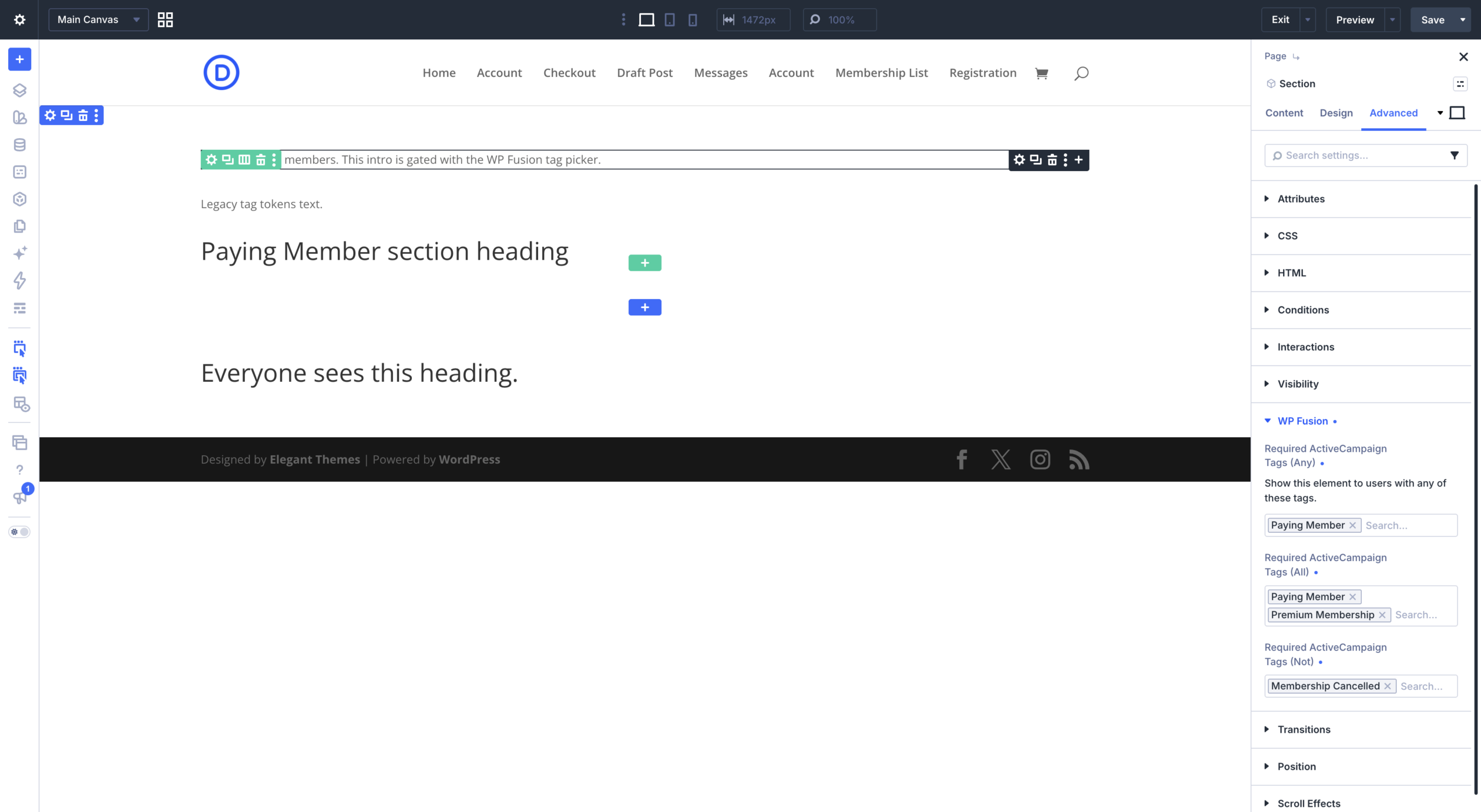
Sections and rows work the same way. Restricting a section hides everything inside it.
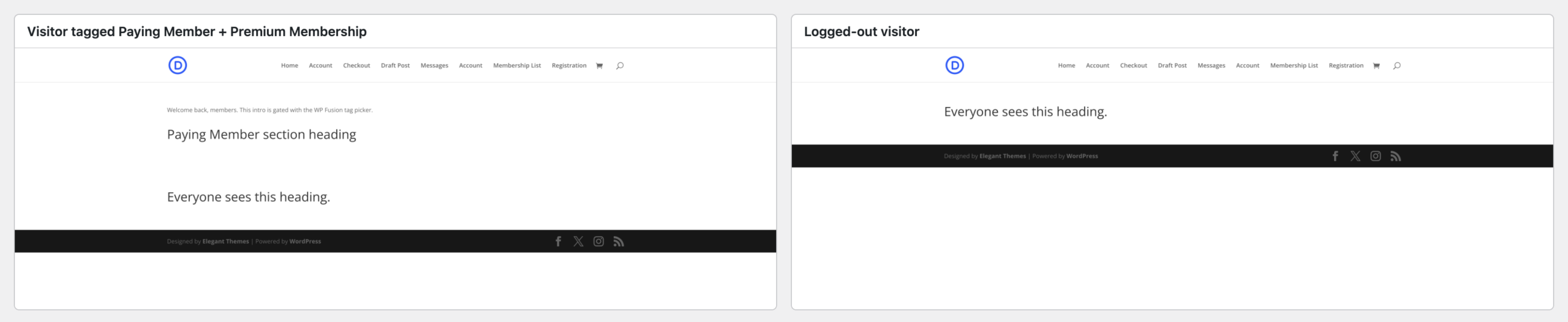
Here is a page set up with the tag pickers, shown to a visitor with the Paying Member and Premium Membership tags (left) and to a logged-out visitor (right):
#Administrators
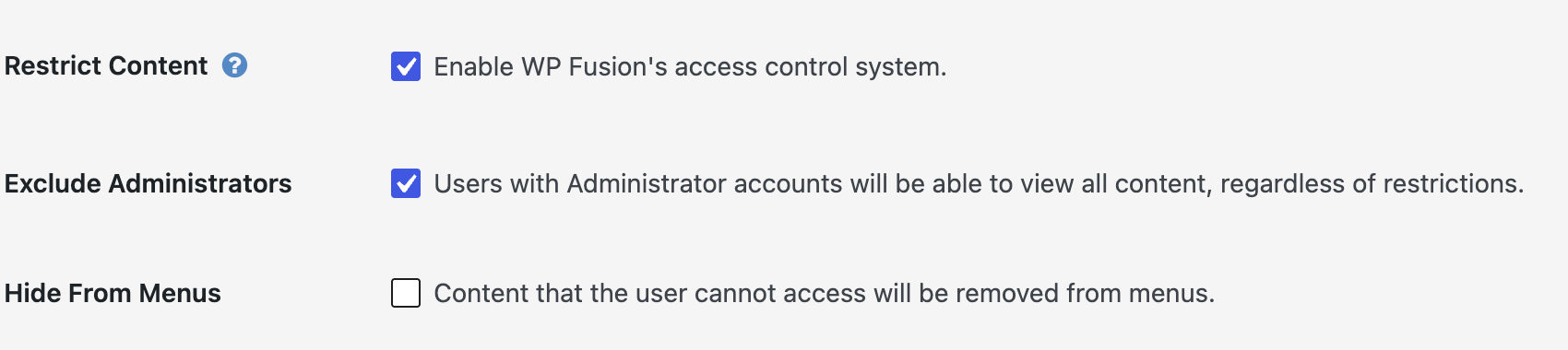
By default, users with an Administrator account can see all Divi modules regardless of their tags. This is controlled by the Exclude Administrators setting in Settings » WP Fusion » General. Turn it off to test your rules while logged in as an Administrator.
#Advanced method
For more advanced control, install and activate the Content Visibility for Divi plugin. When editing any module, you’ll now see a new setting where you can put in rules regarding when that module should be displayed.
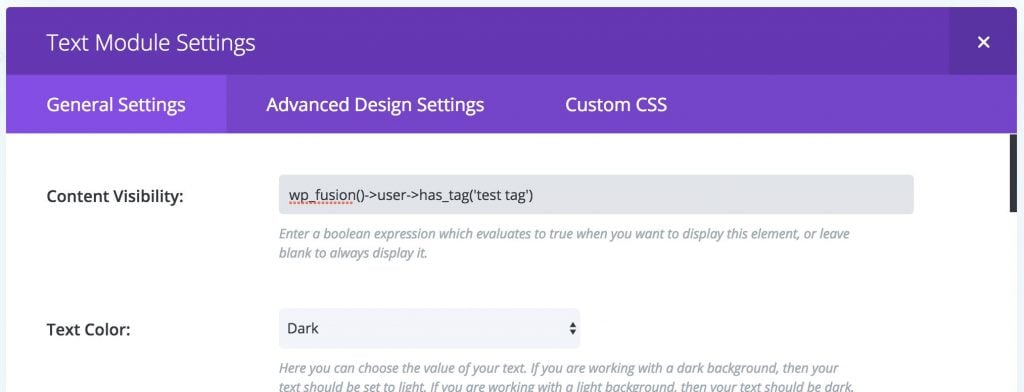
The setting accepts any PHP expression that evaluates to either “true” or “false”. Using WP Fusion’s has_tag() function you can create very specific rules regarding when a module should be displayed.
For example:
- Require the tag Active Subscriber to view the module:
wpf_has_tag( 'Active Subscriber' ) - Require both the Active Subscriber and Gold Member tags to view the module:
wpf_has_tag( 'Active Subscriber' ) && wpf_has_tag( 'Gold Member' ) - Require either the Active Subscriber or Gold Member tags:
wpf_has_tag( 'Active Subscriber' ) || wpf_has_tag( 'Gold Member' ) - Only show the module if the user is logged in and does not have the tag Payment Failed:
! wpf_has_tag( 'Payment Failed' )
#Dynamic CSS
Divi has a feature called Dynamic CSS, which can generate a CSS file for your pages based on just the elements that are visible on the page.
This feature has been known to potentially cause problems with conditionally displaying Divi widgets (both with WP Fusion and Content Visibility).
The reason is, if a user views a page and there are hidden elements, the CSS for that page will be generated without the CSS for the protected elements.
Then when another user views the page and has access to the protected elements, they will be able to view the content (the HTML), but any custom style applied to the elements will be missing, since it wasn’t generated with the dynamic CSS.

If you have issues with irregular styling using WP Fusion and Divi, it’s recommended to disable the Dynamic Module Framework and Dynamic CSS features in the Divi general settings.
#Divi 4
When editing a module in Divi 4, select the Advanced tab, and scroll down to the Visibility section.

There are three settings:
- Required tags (any): You can enter a comma-separated list of tag names or tag IDs. The user must have at least one of the listed tags to see the module.
- Required tags (all): The user must have all of the tags listed here to see the module.
- Required tags (not): If the user has any of the tags listed here, the module will be hidden.
#Upgrading to Divi 5
When you convert a Divi 4 page to Divi 5, with the Divi 5 Migrator or by opening it in the Divi 5 Visual Builder, WP Fusion carries each module’s settings over into its Advanced » WP Fusion group. Your rules are kept exactly as you wrote them, the tag names show up in the pickers as chips, and visitors see the same thing as before.
A few things to know:
- Child modules. Settings on child modules, such as accordion items, are carried over and still enforced on the front end. Because child modules have no WP Fusion group in the Visual Builder, you can’t see or edit those settings there.
- Presets. WP Fusion settings saved inside Divi 4 presets are not migrated.
- Modules with other third-party settings. If a module also has a setting from another plugin that Divi 5 doesn’t recognize, Divi keeps that module as a legacy shortcode module. WP Fusion’s Divi 4 visibility rules are still enforced on it.
Note: In the Visual Builder, a module converted from Divi 4 that carries WP Fusion restrictions can look empty to an editor who doesn’t have the required tags (or to an Administrator when Exclude Administrators is off). The module has not been deleted and still displays for visitors who qualify, so don’t delete modules that look empty.
#Developer Resources
#wpf_divi_can_access
Filters whether the current user can see a Divi module, after WP Fusion has evaluated the module’s tag settings (and the wpf_user_can_access filter). It runs for both Divi 4 and Divi 5 modules. Divi 5 support and the $context parameter require a version of WP Fusion newer than 3.48.0.
/**
 * Let editors always see restricted Divi modules.
 *
 * @param bool  $can_access Whether the user can access the module.
 * @param array $data       The Divi 4 props, or the Divi 5 block attributes.
 * @param array $context    Context for the module being rendered.
 * @return bool
 */
function my_divi_can_access( $can_access, $data, $context ) {

	if ( current_user_can( 'edit_others_posts' ) ) {
		return true;
	}

	// $context['version'] is 4 or 5.
	return $can_access;

}

add_filter( 'wpf_divi_can_access', 'my_divi_can_access', 10, 3 );
Parameters:
$can_access(bool): Whether the user can access the module.$data(array): The Divi 4 module props, or the Divi 5 block attributes.$context(array): Keysversion(4or5),props(the Divi 4 props,nullon Divi 5),attrs(the module attributes) andblock(theWP_Blockon Divi 5,nullon Divi 4).